
Tuesday, October 25, 2011

Monday, October 24, 2011

Saturday, October 22, 2011
You Are Not in Control of Your Own Thinking
 |
| Daniel Kahneman |
Click here to learn more about what Kahneman has to say about the relationship between thought, emotion, human nature, bias, behavior, and the importance of working with people you disagree with.
Literature Fights Evil?
 |
| Evil or Antidote to Evil? |
Rosenbaum seems to think that the neuroscientists' view of evil is overly deterministic. If evil (or lack of empathy) is a matter of neurons, he suggests, then human actors have no "moral agency." Click here to read Rosenbaum's article and let us know what you think.
From the "It's a Small World" department: One of the neuroscientists Rosenbaum cites is Simon Baron-Cohen, cousin of Sacha Baron-Cohen, the infamous British star of the Da Ali G Show, Borat, and Bruno. The connection inspires this question: Does Sacha's comedy encourage empathy or weaken it?
Wednesday, October 19, 2011

Monday, October 17, 2011
Jason Murray: 2011 Crazy Horse Educator of the Year
Dr. McMahon writes:
"Many of you already know our new Assistant Professor of English, Dr. Jason Murray. He is a graduate of ECU.
 |
| Crazy Horse Memorial (model in foreground) in South Dakota |
"What you may not know is that Dr. Murray was recently recognized as 2011 Crazy Horse Educator of the Year for his work teaching at the Indian University of North America.
"We are so pleased to count Dr. Murray as a member of the East Central University faculty. Our students are fortunate to have such a talented and caring teacher. And we, his colleagues in the Department of English and Languages, are terrifically proud of his achievement.
"Please join us in offering Dr. Murray your congratulations."
Thanks, Dr. McMahon. We do!
Thanks, Dr. McMahon. We do!
Thursday, October 13, 2011
What is the role of the writer in the larger culture?
 |
| Hank Lazer (saltpublishing.com) |
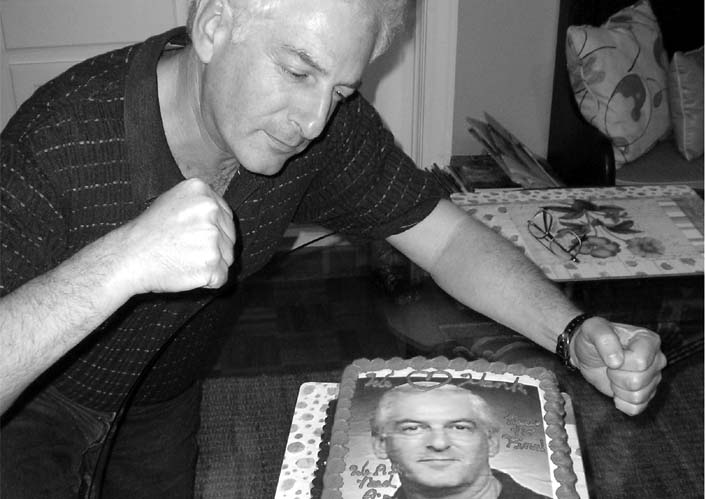
Hank Lazer addressed the question this way when asked in an interview (that's Hank in the photo at left--and on the cake):
"First, I don’t think that there is a fixed “role of the writer” – certainly not a version of what a writer should be. A writer’s range of possible roles will, to a significant extent, be determined by cultural, historical, and local conditions.
"Personally, and in my own circumstances – living in Alabama, in the US, etc. – I think that as a poet I have an opportunity and an ethical imperative to explore and to advocate for non-utilitarian engagements with language. Poets have an opportunity to critique prevailing cultural assumptions and habits, including those of the various overlapping and separate poetry communities. Poetry, as an activity in a capitalist and consumer society, has the capacity to be a rare form of non-alienated labor. The poet’s role thus becomes an example of choosing work/play/labor that, for the most part, is done for its own sake. In the larger culture, the presence of such persons is a challenge and a provocation, as well as a reminder."
Click here to read the rest of the interview.
(Thanks for the heads up, Dr. Tribbey!)
Subscribe to:
Posts (Atom)